Note 11 · Gear Care / Routine
The care rhythm
Fifteen minutes after every walk does more for kit than an occasional big clean. A rhythm of four intervals, and what belongs in each.
Three things wear out walking kit when it is not being used: damp, dirt and being squashed. All three do their work slowly and in storage, which is why a small job done the same evening is worth more than a thorough one done a month later.
This note arranges the jobs by how often they come round.
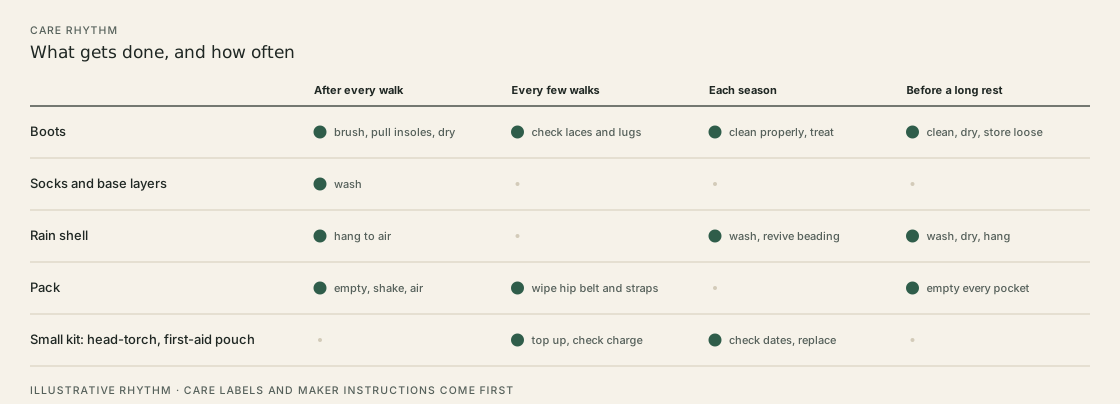
After every walk: fifteen minutes
The after-walk routine is short on purpose. It is not cleaning; it is stopping things getting worse overnight.
| Step | What | Minutes |
|---|---|---|
| 1 | Empty the pack completely and shake it out, upside down | 2 |
| 2 | Boots: knock off mud, pull the insoles, stand them to dry | 4 |
| 3 | Hang the shell and any damp layers on hangers, zips open | 2 |
| 4 | Rinse bottles, clear out food wrappers and crumbs | 3 |
| 5 | Put back what lives in the pack; write down anything used up | 4 |
| Total | 15 |
Step 1 matters more than it seems. A pack that is emptied every time never hides a wet glove or a forgotten sandwich. Step 5 is the one most often skipped, and the reason a plaster or a spare battery turns out to be missing on the next walk.
Every few walks: a look-over
Some wear is too slow to notice in a day and too quick to leave for a season.
- Boots: laces for fraying, lugs for wear, the welt for any gap.
- Pack: wipe the hip belt and shoulder straps with a damp cloth. They collect sweat and salt, which stiffens the fabric and transfers to whatever the straps rub against, including the shoulders of a shell.
- Small kit: check that the head-torch works and is charged, and top up the first-aid pouch.
Each season: a proper clean
Four times a year is often enough for kit used at half-day intensity. More use, or dirtier use, shortens the interval.
- Wash the rain shell and test its finish.
- Clean the boots thoroughly and treat them according to their material.
- Go through the first-aid pouch for anything past its date.
- Look over the pack: stitching at the strap anchors, buckles, zip pulls.
Before a long rest
Kit that will not be used for a couple of months needs putting away, not just putting down.
| Item | Store it | Avoid |
|---|---|---|
| Boots | Clean and fully dry, laces loose, somewhere cool and airy | Sealed bags, damp sheds, hot cars |
| Rain shell | Clean, dry, on a hanger | Folded damp; long compression; direct sunlight |
| Insulated layers | Hung, or loose in a large bag | Months in a stuff sack, which flattens the loft |
| Pack | Empty, every pocket checked, buckles undone, hung or flat | Stored damp, or with food still in it |
| Head-torch | As the maker advises; batteries are often best removed for long storage | Leaving it where a switch can be pressed by accident |
Storage in four words
Clean, dry, loose, dark.
Why a rhythm and not a list
A list is something to get through. A rhythm attaches each job to something that happens anyway — coming home, the fourth or fifth walk, the turn of the season — so that nothing depends on remembering.
The intervals here are a starting point for half-day use, not a schedule to obey. The test is simple: kit comes out of the cupboard clean, dry and complete, or the rhythm needs tightening.