Note 10 · Gear Care / Shells and Layers
When water stops beading
A shell that feels wet inside is not always leaking. Often the outer fabric has soaked, and the fix is a wash, a little heat and sometimes a re-proof.
New rain shells shed water in beads. The drops stand up on the fabric and roll off. After a season or two the same jacket darkens in the rain, feels heavy and cold, and seems damp on the inside. The natural conclusion is that it has started to leak. Usually it has not.
Two layers, two jobs
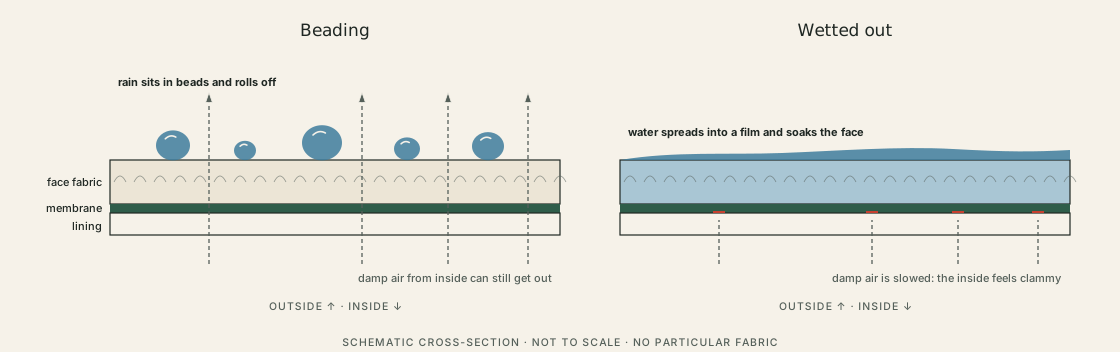
Most waterproof shells are a sandwich. The membrane or coating in the middle is what stops water passing through. The face fabric outside protects it, and carries a thin water-repellent finish, usually called DWR for durable water repellent.
The finish has one task: to keep the face fabric from soaking. While it works, water beads and runs off. When it fails, the face fabric fills with water. This is wetting out. The membrane may still be keeping rain out, but two things change. The soaked outer layer slows the escape of damp air from inside, so sweat condenses against the lining. And a wet layer against the body draws heat away. The result feels exactly like a leak.
The handful-of-water test
Lay the dry jacket flat and flick clean water onto it, a different patch at a time: shoulders, cuffs, the front of the hood, the band where a hip belt sits.
- Water that stands in beads and rolls off when the fabric is tilted means the finish is working there.
- Water that spreads and darkens the fabric within a few seconds means it has gone.
The pattern is usually patchy. Finishes fail first where straps rub and where skin oils reach the fabric, so shoulders, hips, cuffs and collar go long before the back.
Three fixes, in order
Cheapest first
Wash. Then gentle heat, if the label allows. Then re-proof, and only if beading has not come back.
1. Wash. Dirt, smoke, sunscreen and body oils mask a finish that is still there. Close the zips, loosen the drawcords and wash as the care label directs, with the cleaner it recommends. Fabric softener is the thing to avoid: it leaves a film that stops water beading. Rinse thoroughly, since detergent residue does the same.
2. Gentle heat. Many repellent finishes recover with warmth. If, and only if, the label permits, a short spell in a tumble dryer on a low setting is the usual method. If the label forbids heat, hang the jacket to dry and go on to the test.
3. Test again, then re-proof. Repeat the handful-of-water test. If the fabric beads, stop there. If patches still darken, the finish has worn away and needs replacing with a re-proofing treatment.
| Spray-on | Wash-in | |
|---|---|---|
| Goes on | The outside only, by hand | The whole garment, in the machine |
| Good for | Targeting worn areas; garments with a wicking lining | Even coverage with little effort |
| Drawback | Easy to miss patches | Coats the lining as well as the face |
| Then | Follow the product label for drying or heat | The same |
Reading the symptoms
| What you see | Most likely | First thing to try |
|---|---|---|
| Water beads everywhere | The finish is working | Nothing. Hang it up to air |
| Dark patches at shoulders, hips or cuffs | Wear and skin oils where straps and hands touch | Wash, gentle heat, test again |
| The whole face darkens quickly | The finish is masked by dirt, or worn out | Wash and heat; re-proof if nothing changes |
| Damp inside, but the outside still beads | Condensation from working hard in a closed jacket | Open vents and zips sooner; slow the pace on climbs |
| Wet inside at one spot or along one line | A puncture, or seam tape lifting | Look at the seam from inside; ask the maker about repair |
What this note does not cover
Fabrics differ. Some shells have no separate membrane; some finishes do not respond to heat; some makers ask for particular cleaners. The method above is the common pattern, not a specification, and where it disagrees with the label sewn into the garment, the label is right.