A notebook of half-day walks, map reading and kit care Sheet 00 · illustrative terrain throughout
Field Hours

Half-Days · sub-section · 2 notes

Planning

The clock side of a short walk: a four-hour budget and the rule of thumb that fills its biggest line.

Two notes, meant to be read as a pair. The first sets up the window and divides it into moving time, stops, slack and a remainder. The second explains where the moving-time figure comes from and what it quietly leaves out.

Both use elapsed time — T+0:00 at the lay-by — instead of clock time, so the same plan serves a morning or an afternoon.

Note 01 · 3 min read

The four-hour window

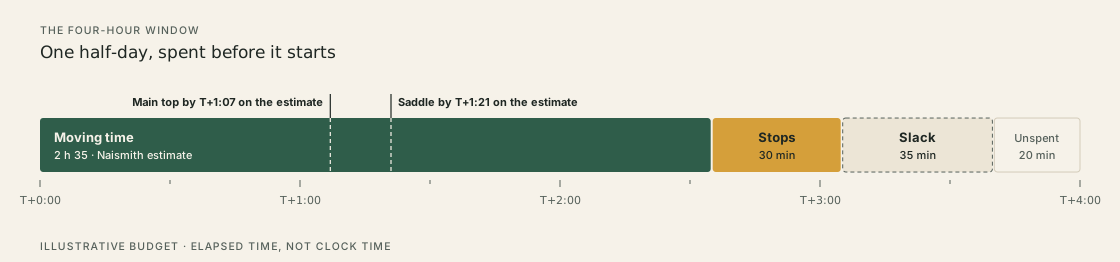
A half-day is a fixed container. Fill it on paper first: moving time, stops, slack, and a little left deliberately unspent.

  • Window: 240 minutes, counted as elapsed time from T+0:00.
  • Sample loop: 2 h 35 moving + 30 min stops + 35 min slack.
  • 20 minutes stay unspent on purpose.

Read the note

Note 02 · 4 min read

Naismith on a napkin

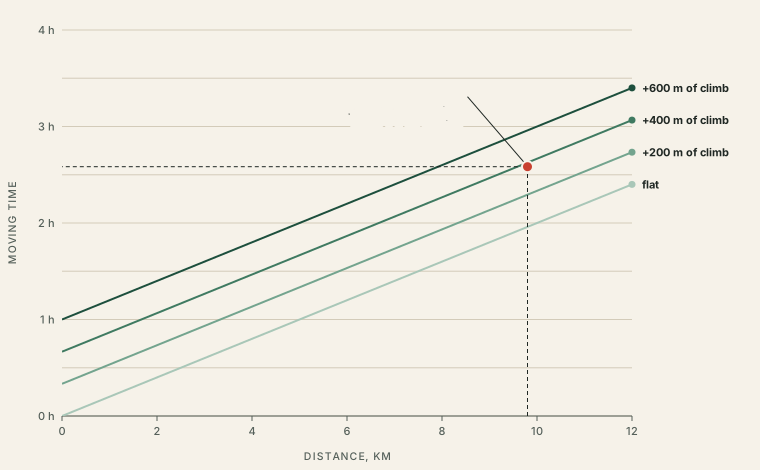
Twelve minutes a kilometre, ten minutes for every hundred metres of climb. The oldest rule of thumb in hill walking, and what it leaves out.

  • 12 min per km plus 10 min per 100 m of climb.
  • Sample loop: 9.8 km, 385 m, about 2 h 35 moving.
  • A baseline only: no stops, no rough ground, no slow descents.

Read the note