Note 01 · Half-Days / Planning
The four-hour window
A half-day is a fixed container. Fill it on paper first: moving time, stops, slack, and a little left deliberately unspent.
A half-day walk has two hard edges: the moment boots leave the lay-by, and the moment they need to be back at it. Everything between is negotiable. This note calls the gap between those edges the window and treats it as a budget of 240 minutes.
The budget is written in elapsed time, from T+0:00 to T+4:00. Clock times tie a plan to one particular morning; elapsed times let the same sheet of paper serve any start.
Four lines in the budget
The window is divided once, before the walk, into four lines. The figures in the right-hand column are for the sample loop on Sheet 00: 9.8 km with 385 m of climb.
| Line | What it pays for | Sample loop |
|---|---|---|
| Moving time | Walking, by the estimate in Note 02 | 2 h 35 |
| Stops | Food, layers on and off, looking properly at the map | 30 min |
| Slack | Slow ground, a wrong turn put right, a tired last hour | 35 min |
| Unspent | Nothing. It is left over on purpose | 20 min |
| Window | 4 h 00 |
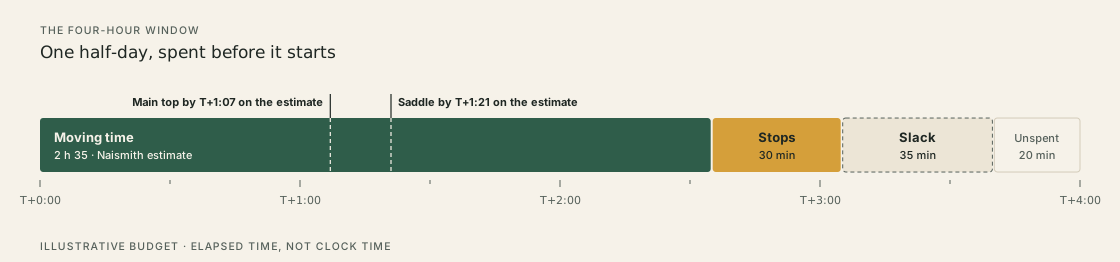
Moving time is the only line that comes from the map. It is an estimate, and the estimate is deliberately plain: distance and climb, nothing else.
Stops are counted separately so that they are not stolen from walking. Thirty minutes on a loop this size is one proper halt and a few short ones.
Slack covers the difference between the estimate and the day. Here it is sized as a share of moving time — 35 minutes against 155, a little over a fifth. On ground that is rough, unfamiliar or likely to be wet, a larger share is the obvious adjustment.
Unspent time is not slack with a different name. Slack is expected to be used; the unspent line is the part of the window the plan never touches.
Working rule
If the four lines do not fit inside the window on paper, the route is too long for a half-day. Shorten the route, not the slack.
From a budget to something checkable
A budget made at the table is only useful if it can be checked on the hill. The estimate gives a time for every waypoint, so any of them can serve as a quick comparison between plan and watch. On the sample loop the estimate reaches the main top at T+1:07 and the saddle at T+1:21, both marked on the bar above.
Those are moving-time figures. Stops and slack push the real arrival later, by an amount that can be worked out in advance; Note 04 turns that into fixed check times and attaches a decision to each.
What the window is not
It is not a target. Finishing with forty minutes unspent is the budget working, not time wasted.
It is not a daylight calculation. Because Sheet 00 is invented, it has no sunset. For a real walk the window has to sit comfortably inside the daylight actually available, and that comes from a current source, not from a notebook.
And it is not a safety device. A budget shows early that a plan is running late. What to do about that is still a judgement made on the day.