Note 02 · Half-Days / Planning
Naismith on a napkin
Twelve minutes a kilometre, ten minutes for every hundred metres of climb. The oldest rule of thumb in hill walking, and what it leaves out.
The estimate behind every time on this site is Naismith’s rule. In the form the Scottish mountaineer William Naismith wrote down in 1892, it allows an hour for every three miles on the map and an extra hour for every 2,000 feet of climb. The usual metric rounding is an hour for every 5 km plus an hour for every 600 m of ascent.
Split into minutes, that becomes something that fits on a napkin:
The rule
12 minutes for each kilometre, plus 10 minutes for each 100 metres climbed.
Straight lines
Because both parts are simple rates, the rule draws as a family of parallel lines. Distance moves you along a line; climb lifts you onto a higher one.
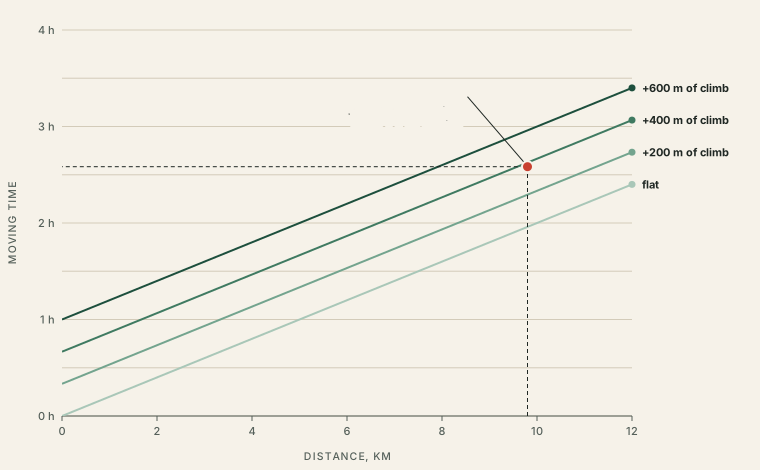
The lines make one thing plain: on a short walk, climb matters more than it looks. Six hundred metres of ascent costs the same hour whether the route is 6 km or 12 km long, so on the shorter route it is a far larger share of the day.
Worked on paper
| Distance | Climb | Distance part | Climb part | Estimate |
|---|---|---|---|---|
| 6 km | 150 m | 72 min | 15 min | 1 h 27 |
| 8 km | 300 m | 96 min | 30 min | 2 h 06 |
| 9.8 km | 385 m | 118 min | 39 min | 2 h 36 |
| 12 km | 500 m | 144 min | 50 min | 3 h 14 |
The third row is the sample loop taken in one piece. Taken leg by leg, with each leg rounded to the minute, the same loop comes to 2 h 35 — a reminder that the last minute of any estimate is noise.
| Leg | From | To | km | Climb, m | Drop, m | Estimate | Running total | Height at end, m |
|---|---|---|---|---|---|---|---|---|
| S–1 | Lay-by on the lane | Spur shoulder | 1.8 | 215 | 0 | 43 min | T+0:43 | 330 |
| 1–2 | Spur shoulder | Main top | 1.0 | 120 | 0 | 24 min | T+1:07 | 450 |
| 2–3 | Main top | Saddle | 1.2 | 0 | 85 | 14 min | T+1:21 | 366 |
| 3–4 | Saddle | West top | 0.7 | 50 | 0 | 13 min | T+1:34 | 416 |
| 4–5 | West top | Plantation corner | 2.1 | 0 | 240 | 25 min | T+1:59 | 174 |
| 5–6 | Plantation corner | West footbridge | 0.8 | 0 | 50 | 10 min | T+2:09 | 124 |
| 6–S | West footbridge | Lay-by on the lane | 2.2 | 0 | 10 | 26 min | T+2:35 | 117 |
| Whole loop | 9.8 | 385 | 385 | 2 h 35 | ||||
Measured on the invented height field behind Sheet 00. Estimate: 12 min per km + 10 min per 100 m of ascent, each leg rounded to the minute. Distances to 0.1 km, heights to 5 m.
What the rule leaves out
Naismith’s figure is for steady walking on reasonable ground with no halts. It knows nothing about:
- Stops. They are budgeted separately in the four-hour window.
- Ground. Tussocks, bog, boulders, mud and undergrowth all slow the pace without changing the map distance.
- Steep descents. The rule adds nothing for going down.
- The party. Fitness, load, group size and the slowest walker’s pace all move the answer.
- Conditions. Wind, heat, wet rock and poor visibility are outside it entirely.
Later refinements exist — Tranter’s corrections, for instance, adjust for fitness and fatigue — but this notebook keeps to the plain rule and puts everything else into an explicit slack line, where it can be seen and argued with.
Making it personal
The rule is a starting ratio, not a verdict. The usual way to tune it is to time a few walks of known distance and climb, compare each with its estimate, and keep the ratio. A walker who is consistently a tenth slower than the rule plans with estimate × 1.1 and stops being surprised.