Note 04 · Half-Days / Route Shapes
Check points and a short cut
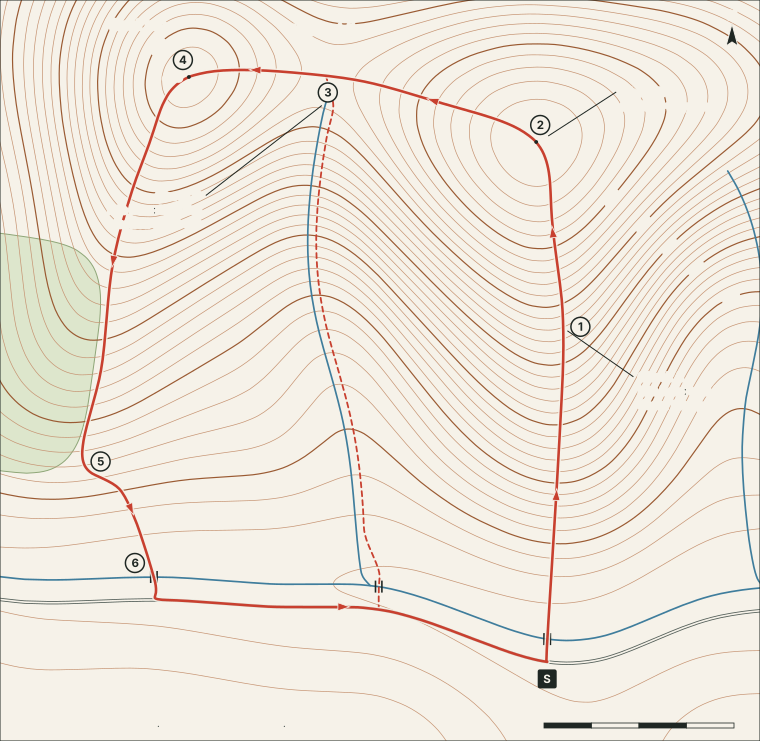
Three places on the sample loop where the watch is compared with the plan, and the one line that turns a late loop into a shorter one.
A time budget says how long a walk should take. A check point says where to look at the watch and what to do about the answer. This note adds three of them to the sample loop, and uses the loop’s single short cut to give the last one teeth.
One ratio for the whole walk
The four-hour window gives the loop 2 h 35 of moving time and allows 3 h 40 before the unspent margin is touched: moving time, stops and slack together. That is 220 minutes of budget for 155 minutes of estimate, a ratio of about 1.42.
Spreading stops and slack evenly along the route gives a simple rule: the budgeted time to any waypoint is its moving-time estimate multiplied by the same ratio.
Working rule
Check time = estimate to that point × (budget ÷ total estimate). For the sample loop, × 1.42.
Three checks
| Check | Where | Estimate | Check time | If the watch says later |
|---|---|---|---|---|
| A | Spur shoulder (1) | T+0:43 | T+1:01 | The climb is costing more than the budget allows. Go back down the spur. |
| B | Main top (2) | T+1:07 | T+1:35 | Carry on to the saddle, but expect to use the short cut. |
| C | Saddle (3) | T+1:21 | T+1:55 | Take the short cut. |
Check A sits two-thirds of the way up the first climb, where most of the day’s effort has already been sampled. It is early enough that turning back is cheap: 1.8 km downhill, about 22 minutes by the estimate.
Check B is the high point. Reaching it late does not force a decision by itself, because the saddle lies on the way to both remaining options. It is a warning to arrive at C with the decision half made.
Check C is the real gate, because it is the last place where the route divides.
What the short cut buys
| From the saddle | Distance | Climb | Estimate | Budgeted | Leave by |
|---|---|---|---|---|---|
| Full loop over the west top | 5.8 km | 50 m | 74 min | 105 min | T+1:55 |
| Short cut down the re-entrant | 3.8 km | 0 m | 46 min | 65 min | T+2:35 |
The Leave by column is 3 h 40 less the budgeted time. Between T+1:55 and T+2:35 the full loop no longer fits, but the short cut still does. That 40-minute band is the entire value of having drawn the line in advance.
Decide at the table
The point of fixing these times beforehand is that they are chosen with a clear head and nothing at stake. On the hill, with the west top in view and only twenty minutes behind, the temptation is to renegotiate. A written check time makes that a visible act instead of a drift.
None of this makes the walk safe. The check times assume the estimate is roughly right and that nothing has changed since the plan was made. Deteriorating weather, a tired companion or failing light are reasons to turn that override any table.