Note 03 · Half-Days / Route Shapes
Loop, lollipop, out-and-back
Three shapes for a short walk, compared by how much new ground they give and how easily they can be cut short.
Most half-day routes are one of three shapes. The choice is usually made by habit — loops feel like proper walks — but each shape handles a shrinking afternoon differently, and that is worth deciding on purpose.
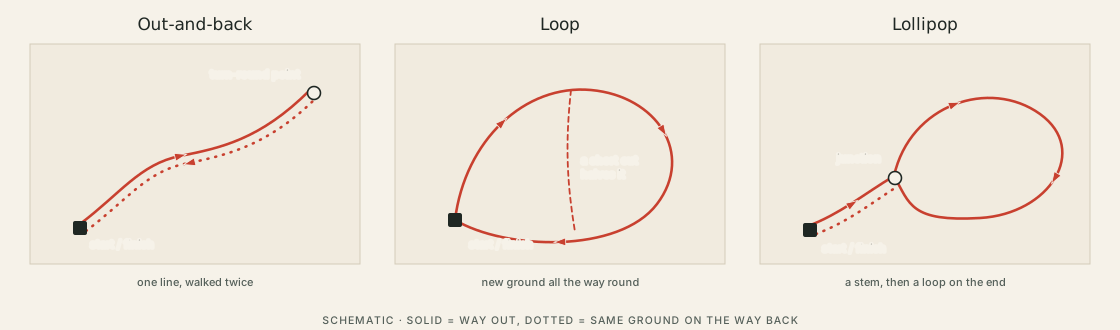
Side by side
| Out-and-back | Loop | Lollipop | |
|---|---|---|---|
| New ground | Half: the return repeats the way out | All of it | Most: only the stem is repeated |
| Navigation load | Lowest. The return has already been seen once, though it looks different facing the other way | Highest. Every leg is new | Medium. New ground on the loop, known ground on the stem |
| Cutting it short | Turn round at any point | Only where a short cut exists, and only if it was planned | Any point on the stem; on the loop, as for a loop |
| Time back from the far point | Roughly known: it is the way out in reverse | Has to be estimated leg by leg | Known for the stem, estimated for the loop |
| Suits | A first look at new ground; a tight window | Ground with clear line features to follow | A start that lies some way from the interesting part |
The out-and-back is not symmetrical
It is tempting to turn an out-and-back at half the available time. That is only right on the flat. If the way out climbs, the way back is quicker by the estimate, and the turn-round point can be later than half-time.
Take 4 km out with 300 m of climb. By the rule in Note 02, the way out is 48 + 30 = 78 minutes. The way back is the same 4 km with no climb: 48 minutes. The far point is reached at about 62 per cent of the moving time, not 50.
Working rule
For an out-and-back, estimate the two directions separately and turn round when the remaining window, less slack, equals the estimate for the way back.
A loop needs its short cut drawn in advance
A loop has a point where going on and going back cost the same. Before it, retreat is cheaper; after it, finishing is. A short cut across the loop moves that point and adds a third option, but only if it has been read on the map beforehand like any other leg: its length, its climb, what it follows and where it comes out.
The sample loop has exactly one, from the saddle down the re-entrant to the lane. Note 04 works out what it saves.
When a lollipop is the honest shape
If the start is a kilometre or two from the ground worth walking, a loop drawn from the start is mostly approach. A lollipop admits that: the stem is the approach, walked twice and easy to follow home, and the loop on the end is kept small enough to finish comfortably. Its junction makes a natural check point, since everything beyond it is commitment and everything before it is retreat.